
You're growing. Orders are up. Your team is working harder than ever. And somewhere in the middle of all that momentum, you hit a wall.
Maybe inventory numbers don't match what's actually in the warehouse. Maybe your sales team is promising lead times that ops can't actually hit. Maybe you're running three different systems and none of them talk to each other.
You've heard that you need either a warehouse management software upgrade or a full ERP for distributors. But which one? And what's the real difference?
This isn't a spec sheet comparison. This is the real conversation growing distribution companies need to have before they spend $50,000 on the wrong solution.
First, Let's Cut Through the Confusion
Here's why most distributors end up frustrated: they Google "warehouse management software vs ERP," read a bunch of vendor blogs, and walk away more confused than when they started.
Every software company has a reason to make their product sound like the answer. So let's set that aside and start with a simple truth:
WMS solves a location problem. ERP solves an alignment problem.
If your biggest pain is inside the four walls of your warehouse, like pick paths being inefficient, stock landing in the wrong bins, and receiving taking too long, a dedicated warehouse management software addresses that.
But if your problem is that your warehouse, your finances, your customer service, and your purchasing aren't on the same page, that's an ERP problem.
Most growing distributors think they have a warehouse problem. What they actually have is a systems alignment problem.
What Warehouse Management Software Actually Does
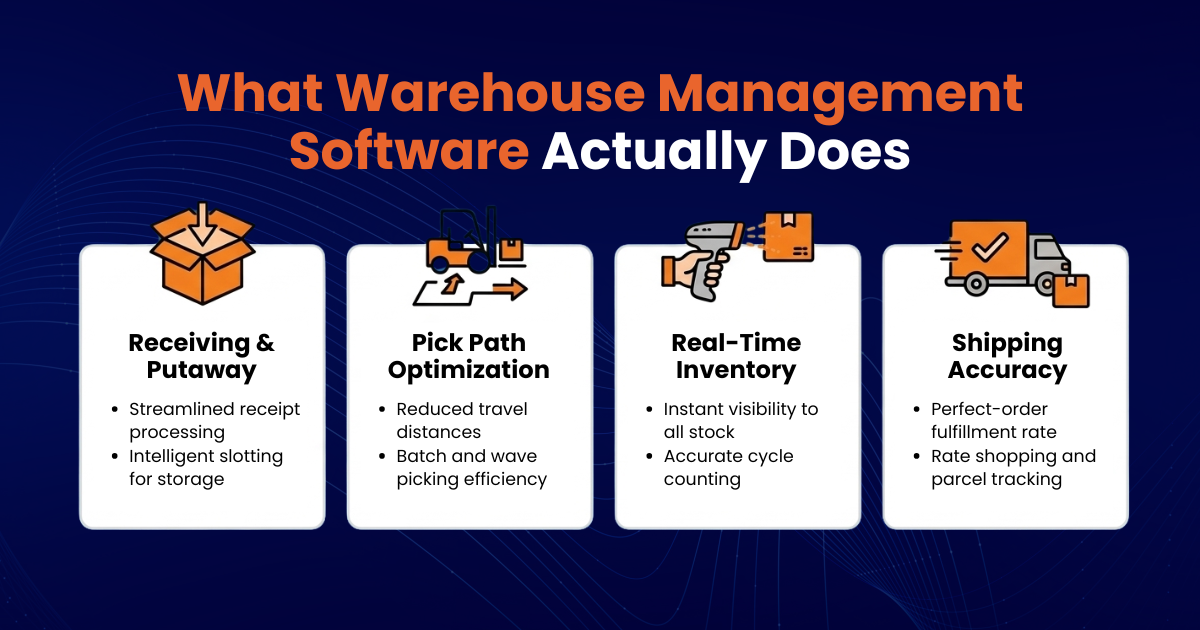
Warehouse management software is built for one thing: optimizing the physical movement of inventory.
A solid WMS handles receiving and putaway, directing product to the right bin based on size, velocity, or SKU logic. It optimizes pick paths, routing pickers efficiently through the warehouse to cut labor costs. It gives you real-time inventory location, meaning you know not just how much you have but exactly where it sits. It tightens shipping accuracy through scanning, verifying, and confirming orders before they leave the dock. And it handles cycle counting so you can run ongoing inventory audits without shutting down operations.
For a high-volume distribution operation with 500+ SKUs, multi-aisle warehouses, and same-day shipping expectations, a purpose-built WMS can be transformational. Picking errors drop. Labor costs drop. Shipping speed increases.
But here's the catch: a WMS doesn't know your customers. It doesn't know your financials. It doesn't know what you promised a buyer last Tuesday. It knows where the box is. Everything else lives somewhere else.
What Distribution ERP Software Actually Does
An ERP system is built for a completely different purpose: connecting every part of your business into a single source of truth.
For distributors specifically, a distribution ERP manages purchasing and vendor relationships, including reorder points, PO creation, and landed cost tracking. It gives you inventory visibility across all your warehouses, not just within one. It handles customer orders and fulfillment from quote to cash, all in one place. It connects your financials directly to your transactions, so cost of goods, margins, receivables, and payables all tie together automatically. And it gives you reporting and dashboards that show you actual business performance, not just box locations.
An ERP for distributors gives your leadership team what a WMS never can: the full picture. You can see that a particular product line is profitable on paper but killing your warehouse labor costs. You can see that one customer accounts for 40% of your volume but 60% of your customer service calls. You can make decisions based on what's actually happening across the entire business.
That's the difference. A WMS optimizes execution. An ERP enables leadership.
The Question Growing Distributors Are Really Asking
Here's what we hear from distribution companies who reach out to Premier Tech Partners:
"We have a WMS. We have QuickBooks. We have spreadsheets. Nothing talks to each other. We're growing fast and it feels like we're running out of runway."
Sound familiar?
This is the hidden danger zone for distributors in the $5M to $50M revenue range. You've outgrown your startup tools. But you haven't yet made the move to an integrated system. So you're stuck patching things together with manual exports, double entry, and Excel reports that somehow became mission-critical.
The real question isn't "WMS or ERP?"
The real question is: "Are we solving the symptom or the cause?"
Many growing distributors reach a point where inventory, purchasing, customer service, and finance all operate in separate systems that don't communicate effectively. This creates delayed reporting, inconsistent inventory visibility, and constant manual work between departments.
PTP's approach focuses on aligning systems, workflows, and operational visibility so leadership teams can make decisions from real-time business data instead of disconnected spreadsheets and outdated reports.
Learn More About PTP's Approach →
The 3 Scenarios That Tell You What You Actually Need
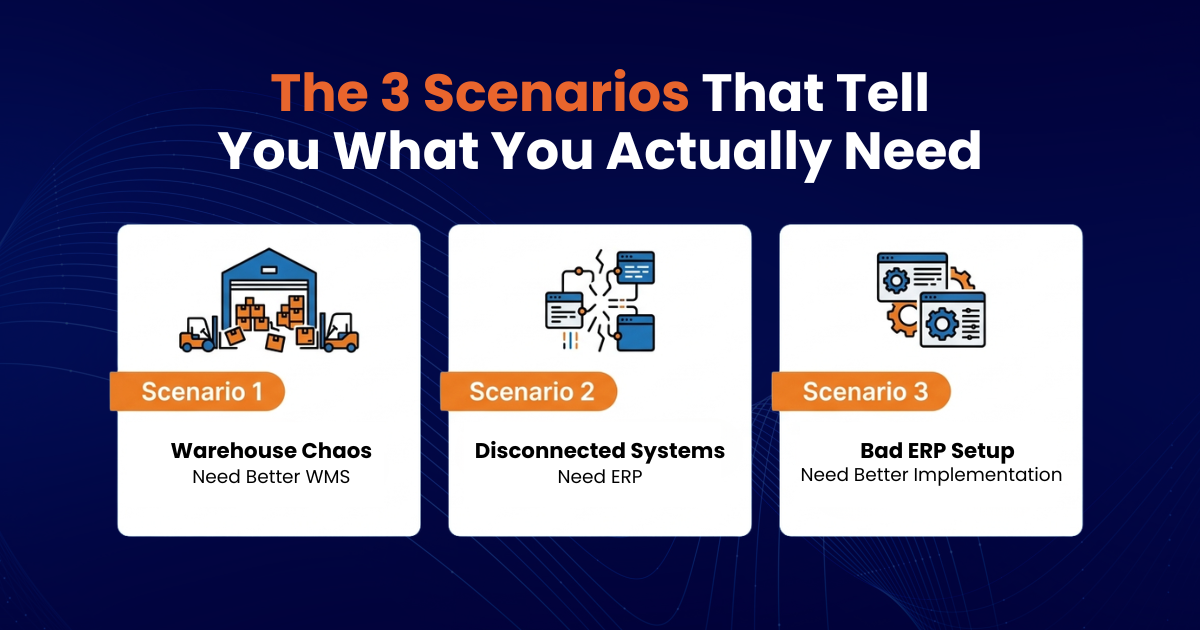
Scenario 1: Your warehouse operations are a mess, but everything else is working
You might just need a WMS, or a better one.
If your ERP or accounting software is solid, your team has visibility into financials and customer data, but the warehouse floor is chaos with bin accuracy off, pickers walking inefficient routes, and shipping errors happening regularly, a standalone WMS or a WMS upgrade makes sense.
This is relatively rare in our experience, but it does happen. Usually in companies that implemented an ERP early and outgrew their warehouse operations.
Scenario 2: You have no real system, just QuickBooks, spreadsheets, and a WMS
You need an ERP, not just a WMS upgrade.
If your warehouse WMS is doing its job but your company runs on a patchwork of QuickBooks, spreadsheets, and phone calls, this is where distribution ERP software transforms your business. You're not just getting better warehouse management. You're getting a system that connects purchasing, sales, fulfillment, and finance into one platform.
Companies that make this move typically see a 30 to 50 percent reduction in manual data handling, a significant drop in order errors that come from miscommunication between teams, and leadership finally able to make decisions based on data rather than gut feel.
Scenario 3: You have an ERP but it's not set up for distribution
You need better implementation and configuration, not a new system.
This is the most common scenario we see. A company bought an ERP two or three years ago, had a rushed implementation, and now half the team doesn't use it properly. The ERP has warehouse management capabilities built in. They're just turned off or misconfigured.
Before you buy anything new, find out what your current system is actually capable of. You might already own the solution.
PTP frequently works with companies that already have ERP systems in place but struggle with poor adoption, disconnected workflows, and manual processes that prevent teams from fully using the technology they've invested in.
Instead of immediately replacing software, PTP helps organizations improve implementation strategy, optimize workflows, and align departments around a more scalable operational structure designed for long-term growth. See How PTP Helps Businesses Scale →
Why Most Distributors End Up Buying the Wrong Thing
The software industry has a dirty secret: features don't fix broken processes.
We see it constantly. A distributor buys a new WMS because picking errors are high. Six months later, picking errors are still high because the root cause was a data problem in the ERP, not a warehouse execution problem.
Or a company invests in a full ERP implementation, but the team never gets trained properly, adoption stalls, and two years later they're still running shadow spreadsheets alongside a system they paid $80,000 to implement.
Technology doesn't fix misalignment. It amplifies it, for better or worse.
That's the insight behind PTP's approach: before recommending a solution, we diagnose the actual problem. Sometimes that's a technology gap. More often, it's a systems alignment problem that no single piece of software will solve on its own.
The Acumatica Advantage for Distributors
If you're a growing distributor evaluating ERP options, one name comes up consistently: Acumatica. And for good reason.
Acumatica's distribution ERP is built specifically for the complexity of wholesale and distribution operations. Unlike legacy ERPs that treat distribution as an afterthought, Acumatica was designed with inventory-driven businesses in mind.
Here's what makes it different for distributors.
Warehouse management is built right into the platform. Acumatica includes WMS functionality natively, including bin locations, directed picking, lot tracking for first-in-first-out and expiration-based workflows, and barcode scanning. You don't need a separate WMS integration that creates sync delays and data conflicts. It's all one system.
Inventory visibility is real-time, across every location. Your sales team can see what's actually available to promise before committing to a customer. Not what was available yesterday. What's available right now, across all your warehouses.
Multi-entity support is native. If you operate multiple distribution centers or subsidiaries, Acumatica handles transactions between them without workarounds. No manual entries. No reconciliation headaches.
Pricing scales with your business, not your headcount. Unlike competitors that charge per user, Acumatica prices based on what you use rather than how many people are logged in. That means your entire warehouse team can access the system without your software costs spiking every time you hire.
It's built to be the last ERP you need. From $5M to $500M, Acumatica scales without forcing you to re-implement or migrate to a bigger product. Companies hit ceilings with QuickBooks, NetSuite, and Sage. Acumatica was designed so you don't have to make that jump again.
Real Example: Key Code Media is a strong example of what this looks like in practice. When they moved from a combination of Sage 100, Sales Logic, and Excel to Acumatica with PTP, the transformation was immediate and measurable. Their team which had grown significantly through acquisitions gained system-wide access without the per-user licensing costs that had made their legacy stack increasingly expensive to scale. Their CFO went from chasing data across disconnected reports to having real-time visibility into project margins and financials. And the cloud deployment alone eliminated over $30,000 in annual server and infrastructure costs. Most importantly, they stopped entering data and started using it. Read the full Key Code Media story
The Real Cost of Waiting
Here's something nobody in the software industry wants to say out loud: the cost of doing nothing is the highest cost of all.
Every month your warehouse team is double-entering orders from your WMS into QuickBooks, you're paying for it in labor. Every time a customer service rep has to call the warehouse to check inventory before promising a lead time, you're paying for it in trust. Every decision made based on a spreadsheet that might be three days old is a risk.
The companies that wait until things break, until a lost customer or a warehouse error forces the issue, always tell us the same thing after implementation:
"We should have done this a year ago."
That's not a sales pitch. That's a pattern we've seen with every client who delayed making the move.
The Bottom Line
If you're a growing distributor trying to decide between warehouse management software and an ERP, here's the honest answer:
Most of the time, what you need is a distribution ERP that includes strong warehouse management capabilities, not two separate systems trying to sync data back and forth.
But the more important question is what's actually causing your pain. A location problem? A visibility problem? An adoption problem? A people-and-process problem?
Getting that diagnosis right is the difference between a technology investment that transforms your business and one that adds another system to the pile.
Ready to Figure Out What You Actually Need?
If you want to find out which category you're actually in, and what the right move is for your specific situation, that's exactly what PTP's discovery process is built for.
Here's what happens when you book a Catalyst360 Discovery Session. We learn how your distribution operation actually runs today, where the real bottlenecks are, and whether the answer is a new system, better use of what you already have, or a phased approach that tackles the highest-impact problems first. No demo until it makes sense. No pressure to pick a platform before you understand the problem.
Schedule a Free Technology Discovery Call with PTP →
See how Acumatica works for distributors →
Already know you need ERP? See PTP's Implementation Services →
SUBMIT YOUR COMMENT