
.png)
Same deal as always: The stories you're about to read? Composites. Think of them as the "greatest hits album" of systems disasters we've witnessed. Names are made up, but the pain? Wasted money? That's 100% real. Any stats I throw at you from research firms are noted separately.
Maybe you caught our last conversation about why growing businesses feel like they're running uphill.
Maybe you didn't. Makes no difference.
Here's all you need to know: Your systems don't talk to each other, and it's costing you way more than you think.
I'm not talking about a few thousand here and there.
I'm talking millions. Literally millions.
Let me show you the math that'll make your CFO cry.
The Math Nobody Wants to See
Alright, grab your coffee for this one.
You're running a $20 million company. Things are good, growing. But something's... off.
Industry studies consistently show that when your systems don't align, and sales says one thing, ops says another, and finance is living in a third universe—you're burning 20-35% of your operational capacity.
Let's play it safe. Call it 25%.
Twenty. Five. Percent.
On $20 million, that's $5 million. Every year. Gone. Poof.
-2.png?width=1200&height=628&name=2%20(1)-2.png)
But wait, there’s more.
It's not just about the waste. It's about what you CAN'T do:
- That game-changing deal that slipped away because you couldn't pull numbers fast enough
- The A-player who quit because they were tired of fighting your janky systems
- That market expansion you've been "planning" for two years but can't execute
- The innovation that's stuck in PowerPoint because your tech can't support it
Add it all up? That $20M company is leaving $7-10 million on the table. Over 2-3 years.
Got a $50M company?
You're looking at $15-25 million. Just... gone.
This is what I call the $50 million misalignment problem.
And here's the kicker—
Most of it? You can't even see it happening.
The Invisible Money Drain
Remember that CEO from last time? Let me tell you what we actually found when we dug deeper.
Picture this: A manufacturing CEO, we'll call her Rachel. Every morning, same ritual. Three dashboards. Three different versions of "the truth." Twenty minutes of detective work just to figure out if they're making money.
But that's just the tip of the iceberg.
When we actually mapped out what this was costing her company:
The obvious stuff:
- Leadership team burning 15 hours a week reconciling reports
- $180K in executive salary wasted on data recovery instead of, you know, leading
- Three major deals delayed 6 weeks each because nobody could confirm the real numbers
The sneaky stuff:
- COO hired a full-time "translator" between systems ($85K/year)
- Every sales rep maintaining their own shadow tracking (2-3 hours/week each)
- Finance running everything twice "just to be safe" (another $120K in redundancy)
The painful stuff:
- Couldn't bid on a $2M contract. Why? Couldn't confirm capacity in time.
- Lost their best ops manager. Exit interview: "I'm done fighting broken systems."
- Delayed new market entry by 8 months. Why? "System limitations."
Total damage: $847,000. First year alone.
-2.png?width=1200&height=628&name=3%20(3)-2.png)
And Rachel's company? Only doing $11 million in revenue.
Scale that to your size. I'll wait while you do the math.
Scary, right?
Your Gut Already Knows This
Let's get real honest here.
How many times this month have you:
- Made a call based on "gut feel" because the data was sketchy?
- Put off something strategic because "our systems can't handle it yet"?
- Watched your team MacGyver another workaround?
- Had that nagging feeling you're missing something important?
That feeling in your stomach? That little voice saying "this isn't right"?
That's your business screaming that things are misaligned.
And here's how it gets worse over time:
Year 1: It's annoying. You adapt. Build some workarounds. "It's fine."
Year 2: It's expensive. The workarounds start breaking. You hire people just to manage the chaos.
Year 3: It's dangerous. You're losing deals, talent, market position. And now? Fixing it requires surgery, not band-aids.
Most companies wait until Year 3.
By then, they've already paid the $50 million tax. And fixing it? Way harder. Way more expensive.
Quick Reality Check: How Bad Is It?
Before we go further, let's see where you stand. Be honest:
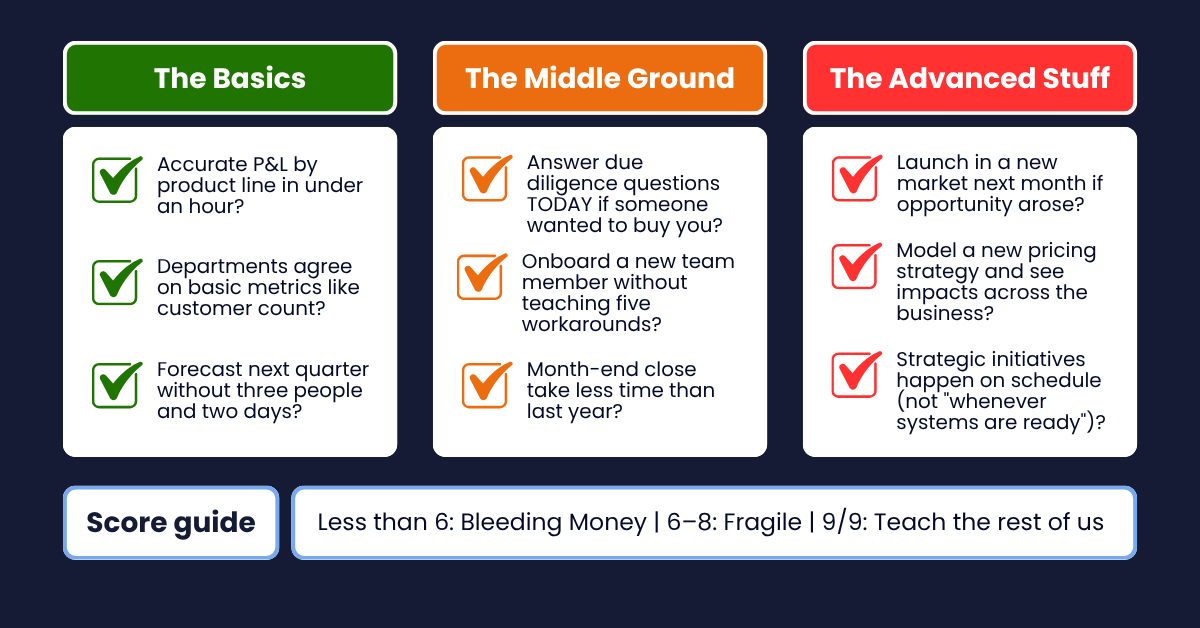
The Basics: □ Can you get accurate P&L by product line in under an hour? □ Do your departments agree on basic metrics like customer count? □ Can you forecast next quarter without three people and two days?
The Middle Ground: □ Could you answer due diligence questions TODAY if someone wanted to buy you? □ Can you onboard a new team member without teaching them five workarounds? □ Does month-end close take less time than it did last year?
The Advanced Stuff: □ Could you launch in a new market next month if the opportunity arose? □ Can you model a new pricing strategy and see impacts across the business? □ Do strategic initiatives happen on schedule (not "whenever the systems are ready")?
Less than 6 checkmarks? You're bleeding money. Daily.
6-8 checkmarks? You're functional but fragile.
All 9? Either you're lying or you should be teaching the rest of us.
The "More Software Will Save Us" Delusion
This is where everyone goes wrong. Everyone.
They think: "We have a technology problem. Let's buy technology to solve it!"
So they add Tableau. Or PowerBI. Or some AI-powered-blockchain-enabled-dashboard-thingy that promises to "unify everything."
Fun fact: The average mid-market company now uses 137 different software applications.
One. Hundred. Thirty. Seven.
Using maybe half the features they pay for.
That's $25,000-$45,000 per year in zombie software licenses. Just sitting there. Doing nothing.
But here's what really kills me—
Every new tool you add creates:
- Another integration that'll break at the worst possible moment
- Another password for people to forget
- Another vendor who'll jack up prices next year
- Another data silo pretending to be a solution
You don't have a tool problem.
You have a "too many tools that don’t link to each other" problem.
The Part Nobody Talks About
Here's what took me forever to figure out:
Your software? It's probably fine.
NetSuite works great. So does SAP. Sage? Solid. Even QuickBooks, it does what it's supposed to do.
The problem isn't the software.
The problem is nobody thought about how they'd work together.
Watch this thriller unfold:
2019: Hit $5M. Need real accounting. Buy QuickBooks, check.
2020: Sales drowning in spreadsheets. Buy a CRM. Now sales and finance speak different languages.
2021: Ops can't track inventory across warehouses. Buy inventory management. Three systems, zero communication.
2022: CEO wants "visibility." Buy a BI tool. Four systems now, plus a new hire to manually make them agree.
2023: You're at $15M. Everything that worked at $5M is on fire. But you're so deep in this stack, starting over feels impossible.
Every decision made sense at the time.
Together? You've built Frankenstein's monster, held together with Excel and prayer.
This pattern is seen in 80% of companies.
And it's not because you lack intelligence, common sense, or good judgement. It's because you were solving today's fire without thinking about tomorrow's inferno.
The Three Layers Where Things Break
Here's what most people miss, misalignment isn't just about technology.
It happens at three layers:
Layer 1: Technology (The Obvious One)
Your systems literally don't talk to each other.
- Sales data trapped in the CRM
- Financial truth locked in the ERP
- Ops running on spreadsheets and hope
- Nobody agrees on anything
Cost: 15-20% efficiency drain from manual data massage therapy
Layer 2: Process (The Sneaky One)
Your workflows don't match reality.
Your ERP thinks you work one way, you actually work another way. So your team builds shadow processes, secret spreadsheets, and "creative interpretations" to bridge the gap.
Cost: 10-15% efficiency loss from working around your tools instead of with them
Layer 3: Strategy (The Killer)
Your technology blocks your business goals.
- Want to expand? "Systems can't handle it."
- New product line? "Too complex for the current setup."
- Better customer experience? "Every touchpoint adds friction."
Your tech is optimized for who you WERE, not who you're BECOMING.
Cost: Unlimited. Every opportunity is delayed or abandoned.
Most companies attack Layer 1 and ignore the others.
That's why nothing really gets fixed.
Why Every "Solution" Makes Things Worse
I'm about to save you millions and months of pain. Pay attention.
The "New ERP Will Fix Everything" Fantasy
Sounds logical: "One system to rule them all!"
Reality check:
- 12-18 months of chaos (if you're lucky)
- $250K-$2M in costs (software, consultants, therapy)
- 50-75% chance of delays or budget explosions
- Your entire team wanting to quit
The punchline? You'll probably have THE SAME PROBLEMS in the new system. Because you just moved your broken processes to fancier software.
The "Big Consulting Firm" Money Pit
You hire McKinsey. Or Deloitte. Or whoever.
They audit everything. Interview everyone. Build beautiful slides.
Three months and $150K later, you have:
- A gorgeous 78-page PowerPoint confirming what you already knew
- A Phase 2 proposal for another $400K
- Zero actual improvement
The report goes in a drawer. Problems remain. Consultants buy another boat.
The "We'll Build Custom Integration" Nightmare
"How hard can it be to connect these systems?"
Famous last words.
Six months and $80K later:
- It "works" (with fingers crossed)
- Breaks every update
- Only one person understands it (and they're updating their LinkedIn)
- You're now a software company instead of whatever you actually do
The "Let's Wait Until It's Really Broken" Strategy
The most popular approach: Do nothing and hope it improves.
Spoiler: It won't.
Systems misalignment is like compound interest, but in a negative way.
Every month you wait:
- Workarounds get more twisted
- Technical debt gets deeper
- Team resistance gets stronger
- The fix gets more expensive
By the time it's "really broken," you're making desperate decisions under pressure. Exactly when you shouldn't be.
Your Three Monday Morning Moves
Enough doom and gloom. Let's fix something.
Move 1: The Money Map (90 minutes)
Track a single customer order from "hello" to "here's your money."
Document:
- Every system it touches
- Every human translation required
- Every "that's just how we do it" moment
- Every place the same data gets entered or manually logged
Count the friction points. If it's under 10, you may be deceiving yourself.
Move 2: The Reality Check (60 minutes)
Pick your three most important metrics:
- Revenue per customer
- Gross margin by product
- Customer acquisition cost
Ask three people to pull these numbers. Compare answers.
If they match, celebrate. If they don't (they won't), you've found your starting point.
Move 3: The Quick Win (This Week)
Find the most INFURIATING manual process in your company. The one everyone jokes about.
Fix it, this week. Even if it's just automating one Excel formula.
Why? Because momentum matters. One fixed friction point proves things CAN get better.
The Three Questions That Matter
Before you do anything else, answer these:
Question 1: If you had perfect visibility—real-time, accurate, trustworthy data. What would you do differently tomorrow?
Not what reports you'd run. What MOVES would you make?
Question 2: What's the ONE operational bottleneck that, if gone, would change everything?
Not a list. THE one thing constraining everything else.
Question 3: If your best people spent 20% less time fighting systems and 20% more time on strategy, what becomes possible?
These aren't philosophical. The answers tell you exactly where to focus.
The Real Cost of Doing Nothing
Let me be brutally honest:
Every month you wait costs you.
For a $20M company with moderate misalignment:
- Month 1: $40K lost
- Month 12: $520K cumulative
- Month 24: $1.1M cumulative
- Month 36: $1.8M cumulative
That's just direct costs.
Add missed opportunities? 2-3x higher.
But forget the money for a second.
What about the weight on your shoulders? The 3am wake-ups wondering if the numbers are right? The frustration of pushing your team harder when the system is the real problem?
You didn't build a business to referee dashboard disputes.
You built it to create value. Serve customers. Build something that matters.
Systems misalignment is stealing that from you. Day by day.
Two Ways Forward
Option 1: The Quick Assessment Download our Misalignment Calculator. Plug in your numbers. See what this is actually costing you. Takes 10 minutes. No email required.
[Get the Calculator →]
Option 2: The Full Story Next up in the series: "The 5 False Solutions That Delay Scaling and Growth." I'll show you exactly why traditional fixes fail and what the 8% who succeed do differently.
[Continue to Part 3 →]
About This Series
This is Part 2 of our deep dive into fixing systems that fight your growth. Each piece works solo—grab value from one or read all twelve for the complete playbook.
About Premier Tech Partners: We help growing companies fix their systems mess without the usual consulting circus. Our Catalyst360 approach has helped 200+ companies stop bleeding money. Maybe you're next.
A Note on the Numbers
The 20-35% efficiency loss from misalignment comes from multiple industry studies over the past decade. The 137 SaaS tools average is from recent industry reports on software sprawl. The implementation failure rates are well-documented in ERP research. All scenarios are composites from patterns we've observed. Real problems, fictional people.
SUBMIT YOUR COMMENT