
You probably didn't wake up one morning and decide your inventory system was broken.
More likely, the warning signs appeared gradually.
A few stockouts here. A spreadsheet that needed "just one more tab." A warehouse manager keeping notes on paper because the numbers in the system didn't match reality. Purchasing starts ordering extra inventory "just to be safe."
Then growth happens.
And suddenly, the processes that helped you get here start slowing you down.
That's the tricky thing about an inventory management process. It rarely fails all at once. Instead, it quietly becomes harder to maintain until your team spends more time managing inventory than managing the business.
If that sounds familiar, you're not alone.
Many growing companies reach a point where their inventory process can't keep pace with increasing complexity. The challenge isn't that the team is doing something wrong. It's that the business has evolved, and the systems supporting it haven't.
Here are the clearest signs your business has outgrown its inventory management process, and what to do next.
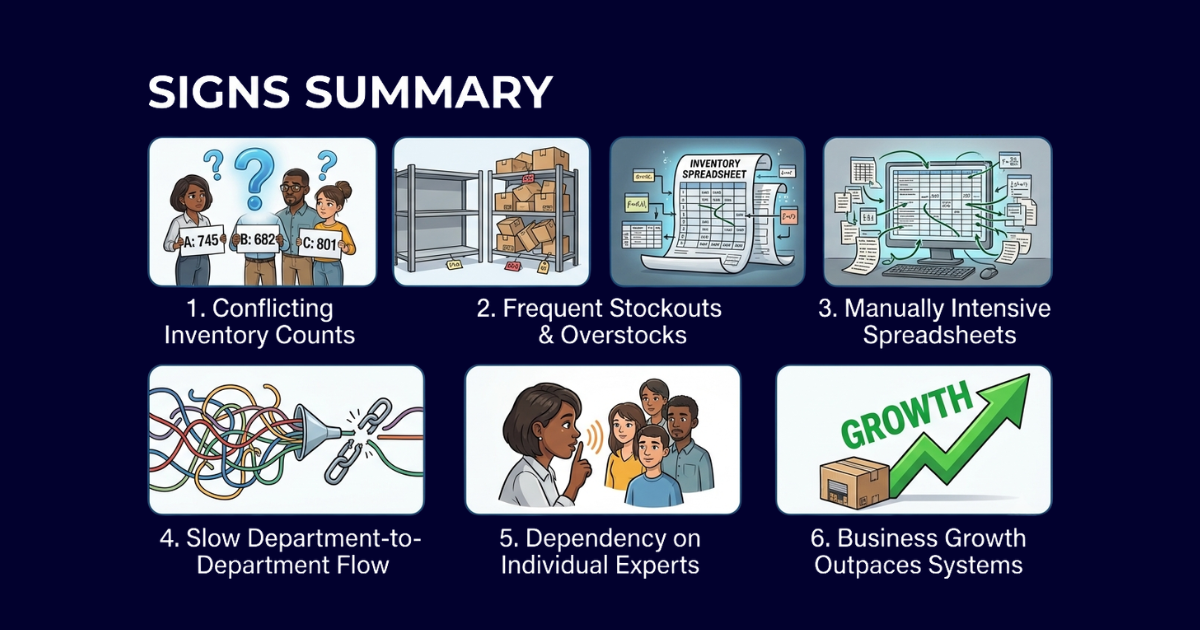
1. Your Team Doesn't Trust the Inventory Numbers
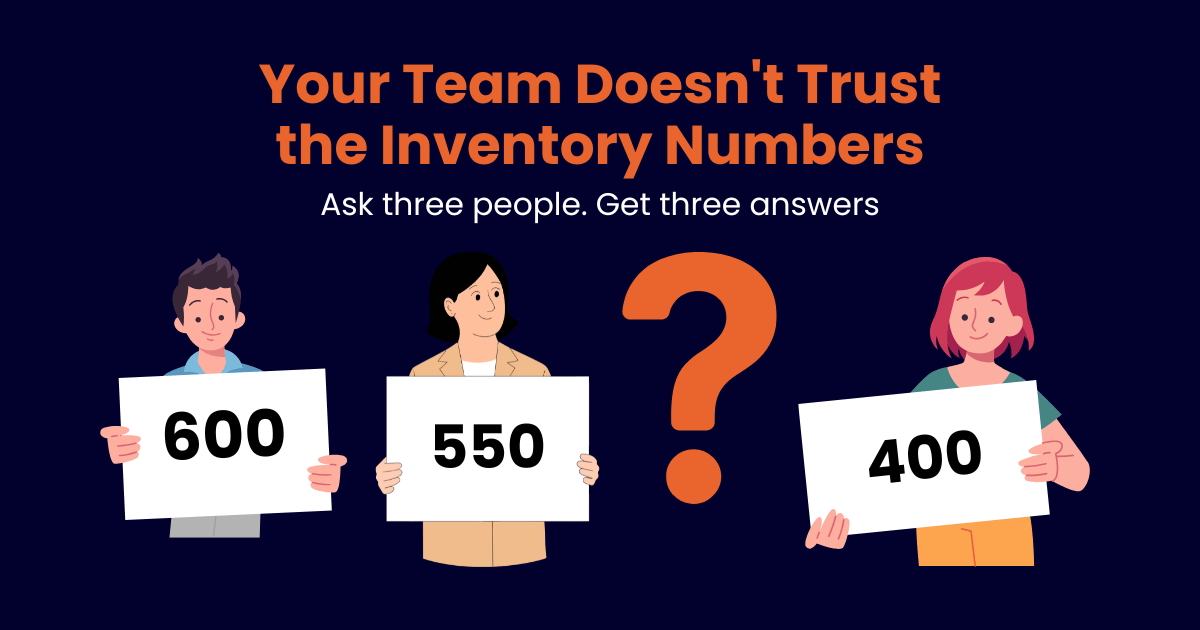
Ask three people how much inventory you have. If you get three different answers, that's a problem.
When teams stop trusting inventory reports, they create their own systems. Spreadsheets to double-check counts. Sticky notes on shelves. Manual reconciliations at the end of the week. Verbal updates instead of relying on the software.
At first, these workarounds feel harmless. But over time, they create more confusion. Data becomes fragmented. People waste hours validating information instead of acting on it.
For many businesses, this is the first major sign they're dealing with an outgrowing inventory system. The issue isn't employee performance. It's that the current system no longer provides a reliable, real-time view of inventory across the organization.
TRA Snow & Sun lived this exact problem. The team was handwriting work orders on colored paper and at times fell six months behind on inventory, with QuickBooks and Salesforce running as disconnected systems that required manually transferring data between them. After implementing Acumatica with Premier Tech Partners, real-time inventory data and automated workflows eliminated the production bottlenecks this caused. Read the full TRA Snow & Sun story →
2. Stockouts and Overstock Are Happening at the Same Time
This one feels almost impossible. How can you run out of popular products while sitting on shelves full of slow-moving inventory?
Yet it happens all the time.
Without accurate inventory visibility and forecasting, businesses tend to compensate. They order more than they need, increase safety stock across the board, make purchasing decisions based on intuition, and react to shortages instead of planning ahead.
The result is cash tied up in excess inventory while customers wait for products you don't have. That's not an inventory problem. That's a business growth problem. And it's often one of the clearest indicators that it's time to rethink your inventory management process.
3. Spreadsheets Have Become Mission Critical
There's nothing wrong with spreadsheets. They're flexible. Familiar. Quick.
But here's the thing. If your inventory operation depends on spreadsheets to function, you've probably outgrown them.
Growing businesses often reach a point where spreadsheets become the glue holding multiple systems together. Maybe inventory lives in one system. Purchasing lives in another. Accounting is somewhere else. So someone exports reports, copies data into Excel, and manually reconciles everything.
It works until it doesn't. One incorrect formula or outdated file can create purchasing mistakes, inaccurate counts, or missed customer orders. And the larger the business becomes, the greater the risk.
This is why many companies begin exploring inventory management solutions that provide centralized visibility instead of scattered data.
4. Inventory Problems Are Affecting Other Departments
Inventory rarely stays an inventory issue. Eventually, it spills into finance, operations, customer service, and sales.
You might notice that customer service can't confidently answer order questions. Finance struggles to reconcile inventory valuations. Sales teams promise inventory that isn't actually available. Operations spends more time fixing errors than improving processes.
Suddenly, everyone feels the pain.
This is an important turning point. Because when inventory friction starts impacting multiple departments, the conversation changes from "how do we improve inventory?" to "how do we improve the way our business operates?"
That's often when leaders begin considering broader solutions like ERP inventory management, where inventory becomes part of an integrated operational system rather than a standalone process.
IOC Construction felt this exact ripple effect. Disconnected systems meant six employees were manually entering and reconciling data across platforms that didn't talk to each other, leading to lost data and inaccurate job costing that affected finance, not just operations. After connecting everything in Acumatica with Premier Tech Partners, expense alerts and reporting became automatic, and leadership could finally see margins and performance across all four of the company's entities in real time. Read the full IOC Construction story →
5. Purchasing Decisions Depend on Tribal Knowledge
Every growing business has that one person.
The warehouse manager who "just knows" when to reorder. The operations lead who remembers supplier timelines. The owner who can estimate inventory levels without looking at a report.
They're incredibly valuable. But they're also a risk.
Because if your inventory process depends on institutional knowledge instead of system-driven insights, growth becomes harder to sustain. What happens if that employee leaves? What happens when you open another location? What happens when order volume doubles?
Scalable businesses rely on processes, not memory. If your team still depends on tribal knowledge, it's one of the strongest signs your business has outgrown its current inventory approach.
6. Your Business Is Growing Faster Than Your Systems
Growth creates complexity. More products, more suppliers, more locations, more customers, more channels.
The systems that worked when you had one warehouse and 500 SKUs may struggle when you have three locations and thousands of products moving through the business. And that's normal. Growth exposes weaknesses that weren't obvious before.
The mistake many companies make is assuming they need more people to solve the problem. Sometimes they do. But often, they need better systems.
That's why the question isn't "is our current process broken?" The better question is "will our current process support where we're going?"
If the answer is no, it may be time to consider upgrading your inventory management instead of waiting for operational friction to become a crisis.
Common Myths That Keep Businesses Stuck
Before companies modernize their inventory operations, they often believe one of these myths.
"We're too small for a better system." Not necessarily. The right system isn't about company size. It's about complexity. A 30-person manufacturer with multiple warehouses may need more sophisticated inventory capabilities than a 300-person company operating from a single location.
"We'll fix it with more spreadsheets." Maybe. For a while. But spreadsheets don't scale well when multiple teams need access to the same information at the same time. Eventually, manual work becomes the bottleneck.
"Upgrading will disrupt everything." This is a legitimate concern. No one wants to pause operations or introduce unnecessary risk. But modern inventory and ERP implementations are often phased. Many businesses improve visibility first, automate workflows second, and optimize operations over time. The goal isn't disruption. It's controlled, strategic improvement.
When Should You Seriously Evaluate Your Options?
There isn't a magic revenue number. No universal employee count. And no perfect moment. But there are patterns.
You should seriously evaluate your options when inventory accuracy is becoming difficult to maintain, when teams rely heavily on spreadsheets or manual workarounds, when stockouts and overstock happen regularly, when inventory issues are affecting the customer experience, and when growth feels harder than it should.
If two or three of those sound familiar, it's worth exploring what's next. Because waiting rarely makes inventory problems easier. Usually, it makes them more expensive.
Why More Businesses Are Moving Toward ERP Inventory Management
The conversation around inventory has changed. Businesses no longer want isolated systems that only track quantities.
They want real-time inventory visibility across all locations. They want automated replenishment based on actual demand rather than guesswork. They want purchasing and accounting integrated so the numbers always tie together. They want better forecasting so they can plan ahead instead of react. And they want a single source of truth that every department can rely on.
That's where ERP inventory management enters the picture. Rather than treating inventory as a separate function, ERP connects inventory with finance, purchasing, operations, and customer service.
The result is more than operational efficiency. It's confidence. Confidence that the numbers are accurate. Confidence that purchasing decisions are based on data. Confidence that growth won't create chaos.
And for many businesses, that's the real goal.
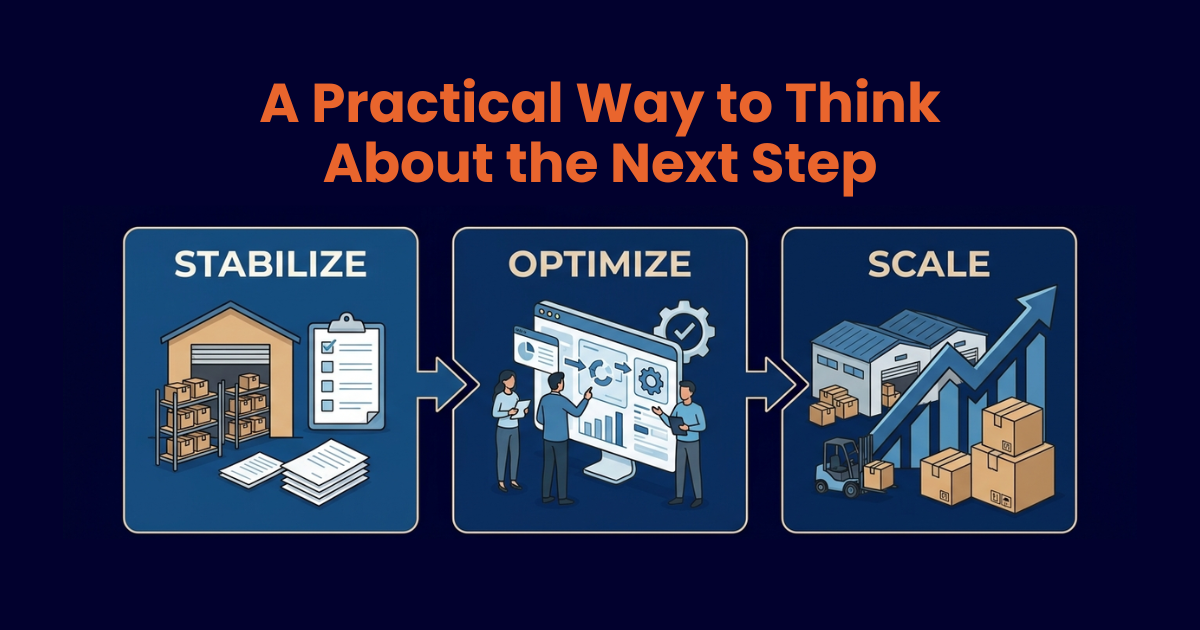
A Practical Way to Think About the Next Step
If your business is experiencing these challenges, you don't need to overhaul everything overnight.
A more practical approach looks like this.
Phase 1: Stabilize. Improve visibility and establish reliable inventory data. Find the friction, clean the data, and create a foundation you can trust.
Phase 2: Optimize. Automate purchasing, replenishment, and inventory workflows. This is where the biggest efficiency gains typically show up.
Phase 3: Scale. Use inventory insights to support expansion, forecasting, and strategic growth. Build capabilities that grow with the business rather than limit it.
This phased approach helps businesses modernize without unnecessary disruption. It also reduces risk because you're solving today's problems while building for tomorrow.
The Bottom Line
The signs your business has outgrown its inventory management process aren't always dramatic.
Sometimes they're subtle. A spreadsheet that grows too large. A warehouse manager working late to reconcile counts. A customer asking why an item was listed as available when it wasn't.
Individually, these moments seem manageable. Collectively, they tell a story. A story that your business is growing. And that growth deserves systems designed to support it.
If inventory is becoming harder to manage, harder to trust, or harder to scale, the answer may not be working harder. It may be building a better foundation.
The businesses that recognize these signs early are often the ones that grow with confidence instead of chaos. And that's a competitive advantage worth paying attention to.
Ready to See Whether Your Inventory Processes Can Support Your Next Stage of Growth?
The next step isn't necessarily buying ERP tomorrow. It's understanding where your visibility gaps are, what's causing them, and whether your current systems can support the business you're becoming.
A Catalyst360 Discovery Session helps you identify the gaps, evaluate your options, and create a roadmap that aligns technology with growth goals, without rushing into a decision.
Schedule Your Discovery Session →
See how Acumatica handles inventory for growing businesses →
SUBMIT YOUR COMMENT