
-1.png)
You've probably already looked at ERP software.
Maybe you sat through a demo. Maybe you got a proposal. Maybe you even started a project that went sideways.
And somewhere along the way, you thought: "Why does this feel so hard?"
Here's the answer no one gives you upfront you skipped the most important step.
Before the software. Before the demo. Before the contract. There's a step that decides whether your ERP project works or falls apart.
It's called an ERP technology roadmap. Most businesses rush through it or skip it completely.
This article breaks down what it is, why it matters, and how to get it right the first time.
5 Signs You Need an ERP Technology Roadmap (Before Anything Else)
Before we get into the details, let's start with a gut check. If any of these sound familiar, this article was written for you.
1. Your systems feel scattered, and your data doesn't tell a clear story. If pulling a single report takes three tools and a bunch of manual work, you don't have a reporting problem. You have a systems problem.
2. Your team is talented but stuck doing manual work. Great people doing repetitive tasks aren't underperforming. They're being underserved by their tools.
3. Growth is making things harder, not easier. Growth doesn't create friction it reveals friction that was already there. If scaling feels like dragging dead weight, your foundation needs attention before your software does.
4. You've looked at ERP before and felt overwhelmed. That's not a "you" problem. That's what happens when the conversation starts with software instead of strategy.
5. You want the right system not just any system. If you're the kind of leader who wants to get this right the first time, the roadmap is where that starts.
If you checked even one of those boxes, keep reading.
So What Is an ERP Technology Roadmap, Exactly?
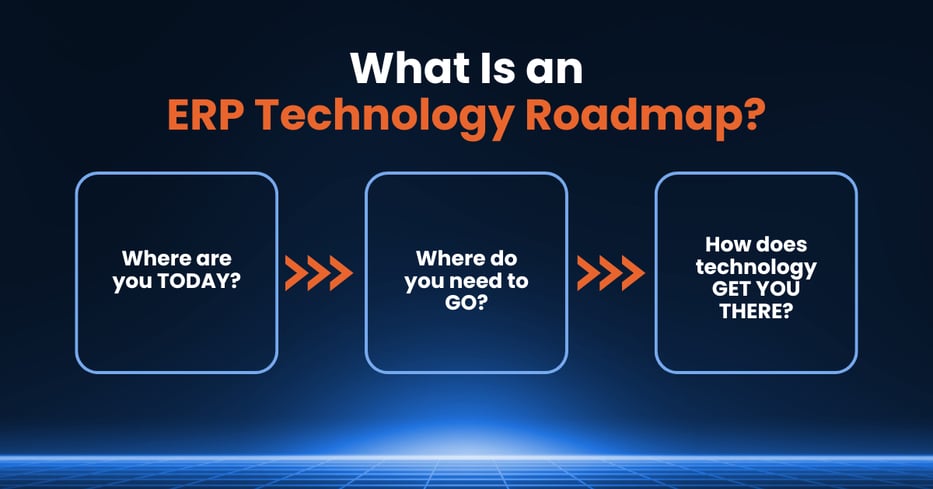
An ERP technology roadmap is a strategic plan that answers three simple questions:
- Where are you today? What's working, what's broken, and what's quietly costing you money.
- Where do you need to go? What your business needs to look like at the next stage of growth.
- How does technology get you there? What tools you need, in what order, and on what timeline.
It's not a software features list. It's not a vendor comparison chart. And it's not your go-live project plan.
Think of it like this: the roadmap is your GPS before the road trip. You wouldn't drive cross-country without knowing your route. Your ERP project deserves the same clarity.
Without a roadmap, you're just installing software and hoping it fits.
Why Most ERP Projects Don't Deliver What They Promised
Here's something worth saying plainly: the technology is almost never the problem.
The real problem is the gap between your systems, your strategy, and your people.
When companies jump straight to a demo, they usually end up with:
- A system built on assumptions not on how the business actually runs
- Teams who resist adoption because no one prepared them for the change
- Integrations that look clean on paper but break under real pressure
- A go-live that creates more disruption than it solves
This doesn't happen because of bad software. It happens because the project started with the wrong conversation.
The right conversation starts with discovery and assessment.
Discovery and Assessment: The Foundation of a Strong Roadmap
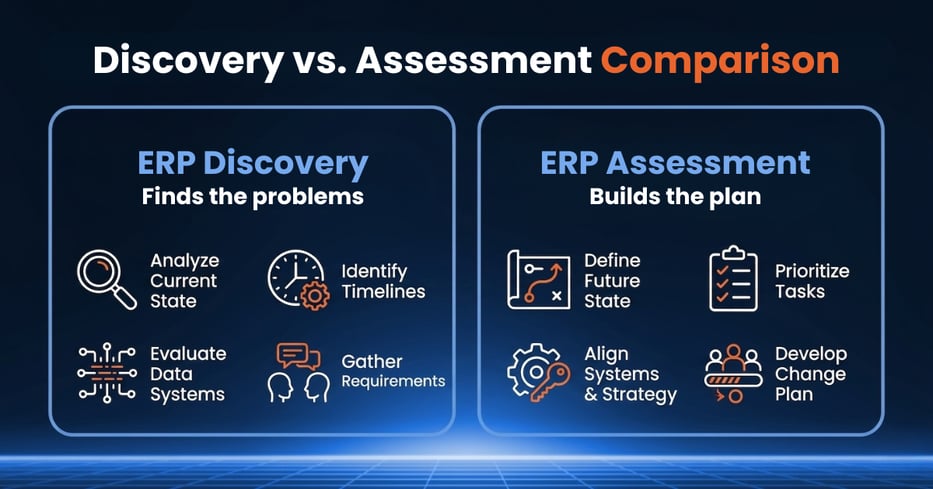
Most ERP vendors separate these into two phases, but for you as a business leader, what matters is the outcome. Here's what this phase should deliver all of it before a single demo is ever booked.
Uncovering What's Really Going On (Discovery)
Discovery is a deep look at your current business, your operations, your tools, your workflows, and your data. The goal isn't to judge. It's to understand what's actually happening so you can build something better.
A thorough discovery process surfaces things like:
- Hidden time drains. Manual processes, duplicate data entry, spreadsheets doubling as databases, things that become invisible when you live with them every day.
- Your real tech stack. Most companies have more tools than they think, and fewer of them connected than they believe. Discovery maps where data flows and where it breaks.
- Problems you didn't know you had. The report that takes three people and five systems to build. The deal you lost because data wasn't ready fast enough. These don't show up on a normal audit.
At PTP, this is what we call the Position Explorer, the first phase of our Catalyst360 roadmap. It gives you crystal-clear visibility into what's working, what's costing you, and what's missing. Think of it as turning the lights on in a room you've been navigating in the dark.
Real Example: Raubex Construction came to PTP after a costly three-year struggle with their legacy ERP. During our discovery phase, we mapped exactly where their operations were breaking down inventory control, data visibility, and reporting were all disconnected. With that clarity in hand, we implemented Acumatica Advanced Construction in just five months. What took three years to get wrong took five months to get right because we started with a clear picture of reality, not a sales demo. Read the full Raubex story →
Turning Insight into a Prioritized Plan (Assessment)
Once you see the full picture, the next step is deciding what to do about it and in what order.
Assessment takes everything discovery uncovered and turns it into a plan that's tied to your goals, your budget, and your team's ability to absorb change without things falling apart.
A strong assessment gives you:
- Mapped requirements not a wish list. What your business actually needs, defined before any vendor conversation. So you walk into every demo knowing exactly what to look for.
- An impact ranking. What should be fixed now? What can wait? What sounds urgent but isn't actually a bottleneck?
- An adoption readiness check. Technology only delivers results when your people actually use it. Assessment looks at your team's readiness for change and builds a plan around it.
- A realistic timeline. One that doesn't burn out your key players or ask the business to change too much at once.
This is what PTP calls the Challenger Solver, the second phase of Catalyst360. It defines exactly what obstacles are holding your business back, and lays out what it takes to remove them. Not guesswork. Not generic best practices. A plan built around your business, specifically.
Real Example: Mid-States Companies came to PTP managing 12 operational entities across construction, manufacturing, millwright, engineering, and trucking all running on disconnected systems. During our assessment phase, we identified that their biggest barrier wasn't technology, it was the lack of a unified operational structure across entities. Before a single line of software was configured, we built a prioritized roadmap that accounted for every entity's unique needs. The result was a clean, phased Acumatica implementation that brought all 12 entities onto one platform without the chaos that typically comes with that scale. Read the full Mid-States story →
Why the Roadmap Has to Come Before the Demo
Most ERP buying processes put the demo first. A vendor books a call, walks you through a polished platform, and everything looks great. So you move forward.
Six months later, you realize the system doesn't match how your business actually runs.
The demo shows you what the software can do. The roadmap tells you what your business needs. Those are two very different conversations.
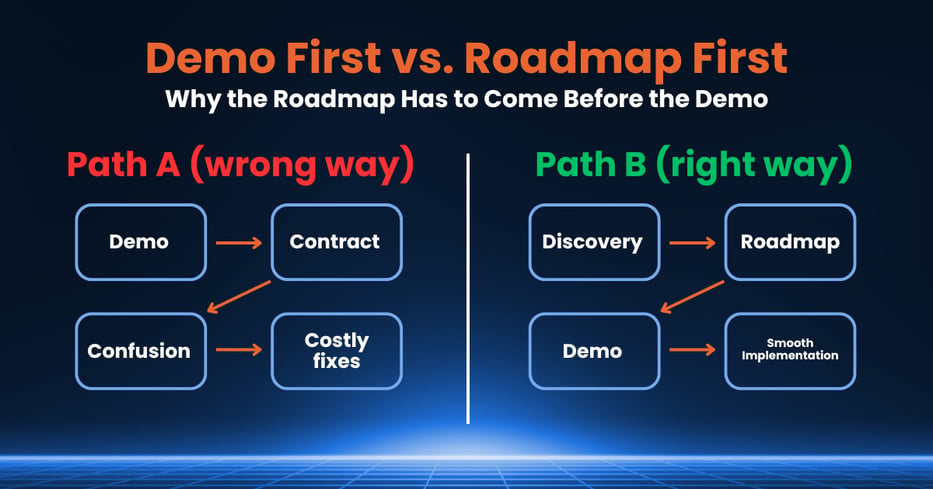
When you build the roadmap first, you walk into every vendor conversation with:
- Clarity on what you actually need not just the features that looked impressive on screen
- Leverage — because you know what matters and what doesn't
- Organizational alignment — so adoption resistance doesn't derail things later
- A baseline to measure success — so you know when the implementation is actually working
Real Example: Carma Group is a fast-growing general contractor serving Las Vegas' entertainment industry known for high-profile projects like the Bellagio grandstand for Formula One with over $100M in revenue. When they came to PTP, they didn't just need software. They needed a clear technology strategy that could scale with their growth. By building the roadmap before selecting or configuring anything, PTP was able to align the implementation with how Carma actually operates, not how a default ERP setup assumes they do. That preparation is what made the difference. Read the full Carma Group story →
What You Walk Away With After a Completed Roadmap
When the roadmap is done right, here's what you have in hand:
A clear picture of where you stand. What's working, what's not, and what's quietly draining time and money you didn't know you were losing.
A prioritized action plan. The highest-impact improvements, in a logical order that respects your team's bandwidth and keeps your operations running while change happens.
A foundation for smarter implementation. Every phase of your ERP rollout runs smoother when it's built on clear requirements instead of guesses.
Alignment across your organization. When leadership, department heads, and end users all see the same roadmap, resistance drops. People trust a plan they helped build.
A partner who knows your business before touching your systems. Not a vendor who configures first and figures it out later.
How PTP Approaches This Differently
Premier Tech Partners built the Catalyst360 roadmap for growth-stage companies that are ready to stop reacting and start scaling with intention.
Here's what makes it different from a typical ERP vendor:
- We start with discovery not demos. We learn your business before we ever talk about software.
- We deliver a personalized roadmap not a generic proposal. Your plan is built around your operations, your team, and your goals.
- We work hands-on with your team not from behind a support queue. We're in the room with you, not just responding to tickets.
- We sequence everything for impact not just for speed. Because rushing an ERP project is exactly how you end up doing it twice.
With 500+ implementations and over 70 years in business, we've seen what works and more importantly, what doesn't. That experience is baked into every Catalyst360 engagement.
What Our Clients Say:
"Partnering with PTP was one of the best decisions we made. Their ERP solution streamlined our processes, saving us time and money. The team was professional, knowledgeable, and supportive throughout the implementation." John D., Operations Manager
"The team at PTP is simply amazing. Their in-depth knowledge of business intelligence and analytics has helped us make data-driven decisions and improve our overall performance." Mike T., CFO
Ready to Build Your ERP Technology Roadmap?
If you've been thinking about ERP or if you've tried before and it didn't land the way you hoped the answer isn't a better demo.
It's a better starting point.
Here's what happens when you book a Catalyst360 Discovery Session:
- We sit down and learn how your business actually runs no assumptions.
- We map your current systems, surface hidden friction, and identify the biggest opportunities.
- You walk away with a clear, prioritized technology roadmap built around your business not around a software vendor's timeline.
No pressure. No generic pitch. Just clarity.
Schedule Your Free ERP Discovery Session →
Because when your systems are built right from the start, everything that comes after gets easier.
SUBMIT YOUR COMMENT