
The first conversation in an ERP buying process may no longer happen with a salesperson.
It may happen with ChatGPT.
A CFO might ask, "What ERP systems are best for a growing distribution company?" An operations leader may ask Perplexity to compare platforms for multi-location inventory. An IT director might use an AI tool to create a shortlist before anyone on the vendor side knows their company is even evaluating ERP.
That shift matters.
For years, ERP research followed a fairly predictable path. Buyers searched Google, visited vendor websites, read comparison articles, asked peers for recommendations, and eventually scheduled demos. Those activities have not disappeared. But AI is adding another layer at the very beginning of the process.
And that layer can influence which ERP vendors make it onto the shortlist in the first place.
AI Search Is Becoming Part of the ERP Research Process
ERP selection creates a difficult research problem. There are dozens of platforms, overlapping feature sets, industry-specific solutions, different implementation models, competing claims, and no universal answer to the question, "What is the best ERP?"
That makes conversational AI attractive.
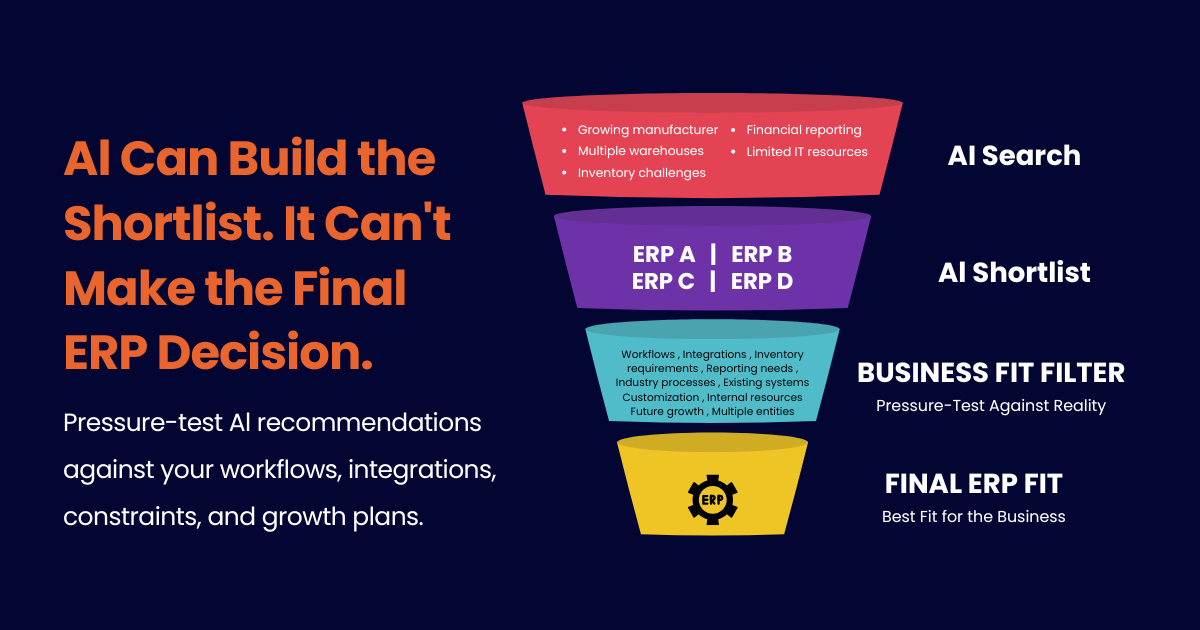
Instead of opening ten browser tabs, a buyer can ask a detailed question: "We are a growing manufacturer with multiple warehouses, disconnected financial and inventory systems, and limited internal IT resources. Which ERP platforms should we evaluate?"
Then the conversation can continue. Which systems handle manufacturing well? Which integrate with our existing tools? What should we ask during a demo? What are the differences between these three vendors? What implementation risks should we consider?
This kind of AI vendor research compresses what used to be a scattered research process into a conversation.
That does not mean AI is replacing traditional ERP evaluation. It means AI may increasingly influence what happens before the formal evaluation even begins.
The Shortlist Can Form Before the Vendor Knows the Buyer Exists
This is one of the biggest changes for ERP providers and consulting firms.
Historically, a buyer searching for an ERP might encounter a vendor through search results, an industry event, a referral, a comparison website, or paid advertising.
With AI search, the buyer may instead ask for a recommendation and receive a synthesized answer containing a relatively small number of options. That creates what is effectively an early shortlist. The buyer can then spend hours researching those companies while never discovering another provider that might have been a better fit.
The question is no longer only whether someone can find you when they search Google. There is another question now: does the information available about your business make it possible for AI-assisted research to understand when you may be relevant?
Those are related questions, but they are not identical.
AI Recommendations Are a Starting Point, Not a Selection Strategy
There is an important distinction here. AI can help someone research ERP. It cannot fully understand a business simply because someone asked, "What ERP should we buy?"
The quality of the answer depends heavily on the quality of the question and the information available.
A recommendation made from a generic prompt may overlook the things that actually determine ERP fit: how orders move through the business, how inventory is managed, what financial reporting leadership needs, which systems must integrate with the ERP, how many entities or locations are involved, what industry-specific processes matter, where employees currently rely on spreadsheets or manual workarounds, what internal resources are available for implementation, and how the company expects to grow.
Those details change the answer. Two businesses with similar revenue and employee counts can need very different ERP environments because their workflows are completely different.
That is why AI-generated ERP recommendations should be treated as research inputs rather than final decisions. AI can help expand the conversation. It should not end it.
Q-PAC Systems is a good example of why an ERP recommendation can only go so far without understanding how the business actually operates. On the surface, Q-PAC was a growing manufacturer that needed better inventory visibility, forecasting, reporting, and production control. But one of its critical requirements went much deeper: the new ERP needed to connect directly with QUIPS, Q-PAC's proprietary product configurator, and support workflows tailored to its unique manufacturing model. Acumatica's open API made that integration possible, allowing configured orders to flow into the ERP with automated BOM creation and real-time inventory visibility. A generic vendor comparison could easily focus on which platforms have strong manufacturing features while missing an integration requirement like this entirely. That is why an AI-generated shortlist should be the beginning of ERP evaluation, not the end.
The Wrong Question Is "What Is the Best ERP?"
There probably is not a useful universal answer.
The better question is: "What ERP best fits the way our business operates, where we are struggling, and where we are going?"
That question changes the evaluation. Instead of starting with product names, start with business requirements. What is breaking today? Where is your team doing duplicate work? Which reports take too long to build? Where does data have to be manually moved between systems? Which processes depend on one person knowing how everything works? What capabilities will the business need two or three years from now that the current environment cannot support?
Once those questions are answered, AI search becomes far more useful because there is something concrete against which recommendations can be tested.
A Better Way to Use AI Search for ERP Vendors
If your team plans to use AI search as part of the ERP buying process, think of it as the beginning of a structured evaluation rather than a shortcut around one.
1. Stabilize: Understand the current state. Before asking which ERP you should buy, document what exists today. Map the core systems, workflows, integrations, reporting requirements, manual processes, and operational pain points. If you cannot clearly explain the problem, it is difficult for an AI tool, ERP vendor, or consultant to recommend the right solution.
2. Catalyze: Pressure-test the shortlist. Now AI can become useful. Ask it to identify possible platforms. Ask what each system is typically designed to handle. Explore differences. Create questions for vendors. Identify areas that require deeper investigation. Then pressure-test what comes back. For every ERP on the shortlist, ask whether it supports your critical workflows, whether it integrates with the systems you plan to keep, what implementation would realistically involve, where customization would be required, what capabilities are native versus requiring additional software, and whether the implementation partner understands businesses like yours. This is where a broad shortlist becomes an actual evaluation.
3. Maximize: Evaluate the long-term fit. The final decision should not simply solve today's loudest problem. An ERP becomes part of the operational foundation of the business. Consider future locations, transaction volume, reporting complexity, acquisitions, additional business entities, automation requirements, new sales channels, and changing operational demands. A platform that solves today's accounting problem but creates tomorrow's operational bottleneck may not be much of an upgrade.
What CFOs, COOs, and IT Leaders Should Look For
Different stakeholders will naturally evaluate ERP recommendations through different lenses.
A CFO may care most about financial visibility, reporting, controls, close processes, and total cost. A COO may focus on inventory, fulfillment, production, workflow efficiency, and the ability to scale operations without continually adding manual work. IT leaders will look closely at architecture, integrations, security, data migration, customization, support, and the burden the new environment will place on internal resources.
None of those perspectives is enough by itself. The strongest ERP evaluation brings them together.
That is another limitation of relying exclusively on AI-generated recommendations. AI can organize information quickly, but someone still has to connect the technology to the reality of the business.
AI Can Make ERP Research Faster. It Cannot Make the Decision for You.
There is real value in using AI during ERP research. It can help buyers understand unfamiliar terminology, organize questions, explore vendors, compare approaches, and arrive at conversations better prepared.
That is a good thing.
But ERP selection still involves a much harder task: connecting software capabilities to the way a real company operates. That requires context. It requires understanding workflows, integrations, pain points, constraints, risks, and future plans. And sometimes it requires recognizing that the platform receiving the most attention is not necessarily the one that fits the business best.
The smartest approach is not to reject AI research. Use it. Just know where its job ends.
Ready to Pressure-Test Your Shortlist?
If your team has already used ChatGPT, Perplexity, Google, software directories, or vendor websites to build an ERP shortlist, the next step is to pressure-test that list against your actual business requirements.
A Catalyst360 Discovery Session helps you evaluate the options, identify gaps, and build a clearer ERP path before you commit to a platform or implementation approach.
Because the goal is not to choose the ERP that appears most often in your research. It is to choose the one that works for your business.
SUBMIT YOUR COMMENT