
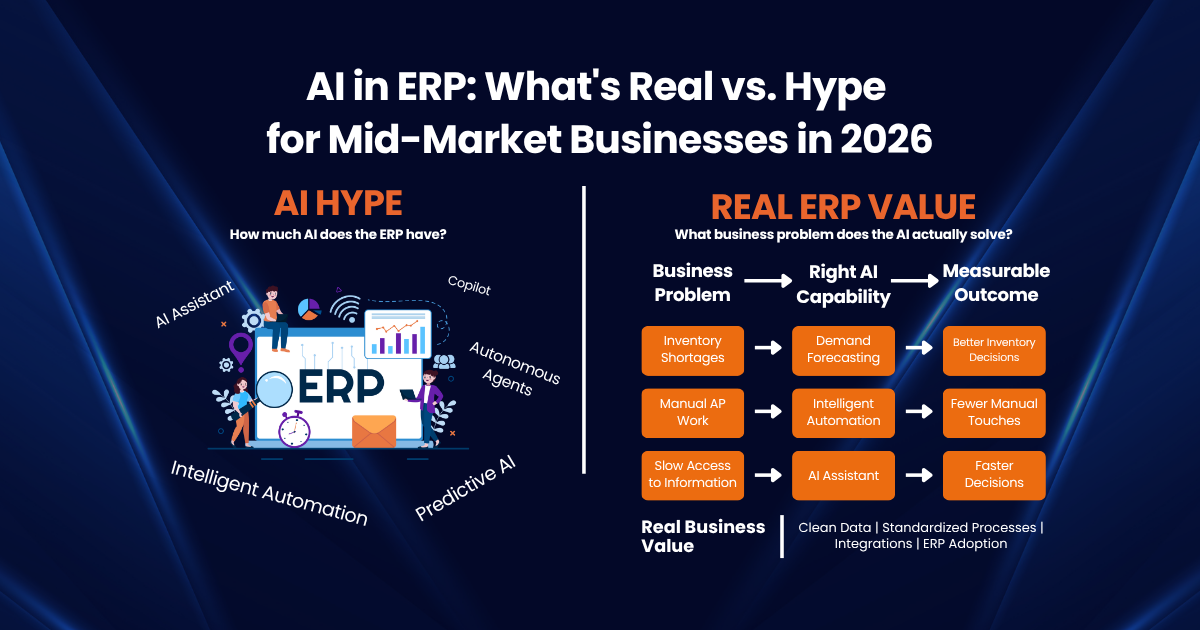
AI has become one of the loudest words in ERP.
Almost every platform now talks about intelligent automation, copilots, predictive insights, AI assistants, autonomous agents, or some combination of the above. If you are a CFO, COO, IT leader, or business owner evaluating ERP options, the natural question is no longer whether a vendor mentions AI.
The better question is: what can the AI actually do for your business today?
That distinction matters.
For mid-market companies evaluating AI ERP software in 2026, the biggest risk is not missing the AI trend. It is making a major ERP decision because a feature sounds impressive in a demo but does little to improve the way your company operates.
The useful conversation starts with business problems, not buzzwords.
AI in ERP Is Real. But Not Every AI Claim Is Equal.
There is practical artificial intelligence ERP functionality available right now.
Acumatica, Microsoft Dynamics 365, and other ERP providers are embedding AI into workflows involving forecasting, anomaly detection, document processing, financial operations, recommendations, automation, and conversational assistance.
Acumatica currently describes AI capabilities around anomaly detection, demand forecasting, exception handling, intelligent automation, and AI-assisted access to business information. Its 2026 R1 release also introduced early access to an AI Assistant, with broader availability planned later in 2026.
Microsoft is pushing Dynamics 365 further toward what it calls agentic ERP. Its current portfolio includes Copilot experiences and agents designed for processes such as account reconciliation, supplier communications, and time and expense management. Its 2026 release planning shows continued expansion of AI-powered agents across Business Central sales and purchasing scenarios.
Those are meaningful developments. But they do not mean every company suddenly needs an "AI-first ERP strategy." And they certainly do not mean every feature carrying an AI label will create measurable value for your organization.
The First Test: What Problem Does the AI Solve?
A simple question cuts through a surprising amount of ERP marketing:
What specific workflow gets better because of this AI feature?
If nobody can answer that clearly, keep asking.
A useful AI capability should connect to an operational outcome you already care about. Maybe your finance team spends too much time identifying unusual transactions, and anomaly detection could help. Maybe purchasing teams constantly react to demand changes, and better forecasting could matter. Maybe employees waste time searching across ERP records for information that should take seconds to find, and a well-designed AI assistant could reduce that friction. Maybe accounts payable still depends heavily on repetitive manual processing, and intelligent document recognition could have a direct business case.
Notice what all of those examples have in common. The business problem comes first. The AI comes second.
That is the foundation of a good ERP strategy.
Q-PAC Systems is a good example of why the problem has to come first. Before moving to Acumatica, the fast-growing manufacturer relied heavily on QuickBooks and Excel, with disconnected systems making forecasting largely guesswork. Inventory shortages were stalling production, order tracking was manual and unreliable, and reporting required hours of spreadsheet work. Rather than starting with a list of advanced features, the solution focused on the underlying operational problem: connecting Q-PAC's configurator to the ERP, automating BOM creation, centralizing inventory data, and giving teams real-time visibility. The result was more reliable inventory forecasting, fewer shortages, and hours saved each week in reporting. The same discipline should apply to AI: identify the bottleneck first, then determine whether AI is actually the right tool to solve it. Read the full Q-PAC Systems (Elkton, Florida)
Before AI, Check the Foundation
This is where many AI ERP conversations go wrong. Companies jump directly to "which ERP has the best AI?" when a better sequence of questions would serve them far more.
Is your data reliable? Are your processes standardized? Do your systems communicate properly? Do employees actually use the ERP correctly? Where are people doing repetitive work that technology could realistically improve?
Artificial intelligence depends heavily on the information and processes surrounding it. If inventory data is inconsistent, customer records are duplicated, workflows are poorly defined, or employees regularly work around the ERP, AI has a weaker foundation to work from.
Think of AI as an accelerator. It can accelerate good processes. It can also accelerate bad ones.
A company with fragmented master data, inconsistent processes, weak integrations, and low ERP adoption will not fix those problems by adding an AI agent. It may actually automate confusion faster.
What to Actually Ask When Evaluating AI in Any ERP Platform
Instead of comparing vendors by counting AI features, evaluate each capability against five practical questions.
What business problem does it solve? Avoid vague answers such as "increases productivity." Ask which task changes, which user benefits, and what becomes faster, easier, or more accurate. If the answer is abstract, the value probably is too.
Is the capability available today? A compelling roadmap is not the same thing as usable software. "Available," "early access," "preview," and "planned" are not interchangeable terms. Confirm whether the feature is generally available, preview-only, restricted by edition, or scheduled for a future release. This applies equally to Acumatica, Microsoft, and every other vendor making AI claims.
What data does it depend on? AI outputs are only useful if the underlying information is trustworthy. Understand which ERP records, external systems, historical data, or integrations feed the feature. If the answer is "clean, consistent data you don't currently have," the AI project is actually a data quality project first.
How will you measure success? Define the metric before implementation. That could be fewer manual touches, faster reconciliation, lower exception volume, improved forecast accuracy, reduced processing time, or better user adoption. Without a success metric, an AI initiative can easily become an expensive demonstration rather than an operational improvement.
Does it fit the broader ERP strategy? This is the most important question. Your company should not redesign its ERP roadmap simply because vendors have introduced new AI capabilities. The technology should support where the business is going. Not the other way around.
The CFO, COO, and IT Team Should Ask Different Questions
AI affects different leaders differently, and a strong ERP strategy brings all three perspectives together.
For a CFO, the issue is value and control. Does the feature shorten financial processes, improve visibility, reduce repetitive work, or support better decisions without introducing unacceptable risk? The CFO needs to know that AI-generated insights are trustworthy enough to act on, not just interesting to look at.
For a COO, the focus is operational performance. Can AI reduce bottlenecks, surface exceptions sooner, improve forecasting, or help employees respond faster? The COO cares whether the capability works in the daily reality of operations, not just in a controlled demo environment.
For IT, the questions become more technical. Where does the data go? How is access governed? What integrations are required? How configurable is the capability? What happens when the model produces a poor recommendation? IT needs to understand the maintenance burden and security implications, not just the feature set.
When one department buys innovation without the other two at the table, someone inherits the operational consequences. Getting all three perspectives aligned before evaluating AI features prevents that.
What Is Mostly Hype?
A few patterns should make ERP buyers cautious.
Be skeptical when a vendor talks extensively about AI but struggles to demonstrate the exact workflow it improves. If the demo shows something impressive but nobody can explain which employee's job gets better and by how much, the feature may be more marketing than substance.
Be cautious when future roadmap capabilities are discussed as though they are already operational. Every ERP vendor has a roadmap. The question is what's available today, not what might be available in 18 months.
And pay attention when an AI feature looks impressive in a controlled demonstration but requires data quality, integrations, licensing, or process maturity your company does not currently have. That doesn't automatically make the technology bad. It simply changes the business case. And that distinction is critical.
The Best AI ERP Strategy Starts With ERP Strategy
The companies that get the most from AI will probably not be the ones that buy the largest number of AI features. They will be the ones that know where intelligence and automation can create measurable value.
Start by stabilizing the foundation: processes, data, integrations, reporting, and adoption. Then identify targeted opportunities where AI can remove friction or improve decision-making. Only after those capabilities prove their value should you expand them across more workflows.
That approach may sound less exciting than "transform your business with AI." But it is far more likely to produce a return.
The real opportunity with AI ERP software in 2026 is not having the most AI. It is knowing exactly where AI belongs in your business, where it does not, and what must be fixed before it can deliver value.
Fabuwood Cabinetry shows why the foundation matters before adding more advanced technology. As the company grew, QuickBooks struggled to keep up, data corruption became a recurring problem, and manufacturing, inventory, and finance information remained fragmented across siloed systems. Data mismatches slowed reporting and forecasting, while manual reconciliation consumed additional time. Moving to Acumatica unified those functions, integrated more than 15 third-party applications, and created a single source of truth with clean, accurate data flowing across the business in real time. That work may not sound as exciting as adding AI, but it is exactly the kind of foundation AI depends on. Better intelligence starts with information you can trust. Read the full Fabuwood Cabinetry Corp
Ready to Figure Out Where AI Actually Fits?
If you are evaluating Acumatica, Microsoft Dynamics, or another ERP platform, the most valuable thing you can do is start with your operating requirements before comparing AI feature lists.
A Catalyst360 Discovery Session helps you map your current systems, identify the gaps that actually matter, and determine where AI can realistically create value before you make a platform decision. Not a feature comparison. A strategy conversation.
Schedule Your Discovery Session →
See how PTP approaches ERP strategy for mid-market businesses →
SUBMIT YOUR COMMENT